Introduction
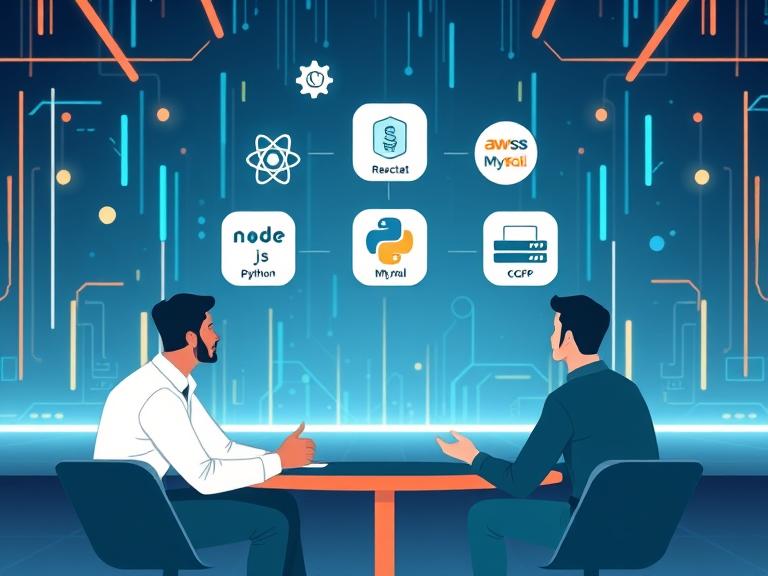
Every startup begins with an idea—but turning that idea into a successful product requires the right technology stack. Your choice of frameworks, programming languages, and tools will directly impact scalability, performance, cost, and long-term sustainability.
In this blog, we’ll guide you on how to choose the right tech stack for your startup, step by step.
1. Understand Your Startup’s Goals
Before deciding on a stack, ask yourself:
- Do you need to build an MVP quickly?
- Is scalability more important than speed?
- Do you require real-time features like chat or live updates?
Your business goals should define your tech stack—not the other way around.
2. Frontend Technology
The frontend is what your users see and interact with. Choose a framework that is fast, responsive, and widely supported.
✅ Popular Choices in 2025:
- React.js / Next.js → Great for dynamic, SEO-friendly web apps.
- Vue.js → Lightweight and beginner-friendly.
- Angular → Suitable for large, enterprise-level apps.
3. Backend Technology
The backend powers your business logic and connects your database. Consider factors like performance, scalability, and developer availability.
✅ Common Options:
- Node.js (Express/NestJS) → Scalable, event-driven, perfect for startups.
- Laravel (PHP) → Rapid development, great for MVPs.
- Django (Python) → Secure, suitable for AI/ML integrations.
- Spring Boot (Java) → Enterprise-grade, stable.
4. Database Selection
Choosing the right database ensures smooth handling of data.
✅ Options:
- SQL (MySQL, PostgreSQL) → Reliable, structured, ideal for transactions.
- NoSQL (MongoDB, Firebase, Cassandra) → Flexible, scalable, good for large unstructured data.
? Hybrid approach (SQL + NoSQL) is common in 2025 for scalability.
5. Hosting & Cloud Infrastructure
A good cloud provider ensures security, scalability, and cost-efficiency.
✅ Options:
- AWS → Complete cloud ecosystem.
- Google Cloud → AI/ML integrations.
- Microsoft Azure → Best for enterprise apps.
- Vercel / Netlify → Best for frontend hosting & startups.
6. Budget & Resources
A startup must balance quality and cost. Open-source technologies help reduce expenses. Also, choose a stack with plenty of skilled developers available in the market.
Example: Node.js developers are easier to find (and cost-effective) compared to specialized Scala developers.
7. Scalability & Future Growth
Don’t just think about your MVP—think about where your startup will be in 2–5 years. Your stack should handle more users, more features, and more data without requiring a complete rebuild.
8. Security Concerns
Cybersecurity is critical. Choose frameworks that offer built-in security features and allow easy compliance with regulations like GDPR, HIPAA, etc.
9. Community & Ecosystem Support
Always go for a stack that has active community support, frequent updates, and plenty of documentation. This ensures faster development and troubleshooting.
10. Test with an MVP First
Instead of overthinking, build a Minimum Viable Product (MVP) with your chosen stack. This gives real-world validation on whether the stack suits your business needs.
✅ Conclusion
Choosing the right technology stack is one of the most important decisions for your startup. Focus on your goals, scalability, budget, and future vision. Remember—there’s no one-size-fits-all stack. The best choice is the one that aligns with your product and business needs.
Need expert help? At 8Bit Solution, we help startups build powerful, scalable, and cost-effective solutions with the right technology stack. Let’s discuss your project today!